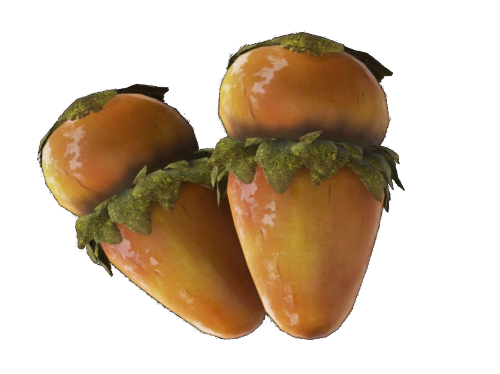
Golden Medmons
Grown in temperate climates on the maru ebony tree, golden medmons are left to fall off the tree when ripe and collected. The fruit at that stage is extremely firm and astringent. They only become edible after being ‘bletted’ or softened through ethylene ripening. Once softening begins, the skin wrinkles and darkens, while the inside flesh is loses moisture until it has a creamy consistency and a flavor reminiscent of caramelized lactose. This process can confuse those new to medmons, as the bletted fruit looks as if it has gone off.
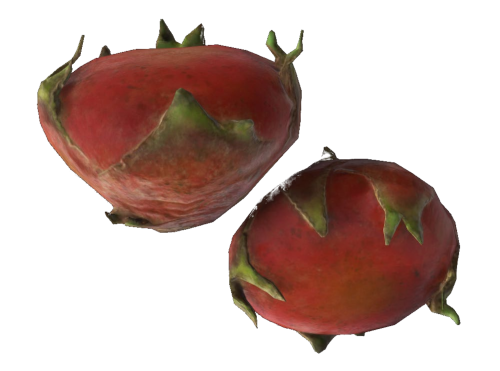
Pitambu
The skin of the pitambu is thin and waxy and easily peeled away using its green leaf-like growths. Inside is a crisp and watery bright red flesh filled with tiny white seeds that have a mild, nutty taste. The flesh and seeds are traditionally consumed together.
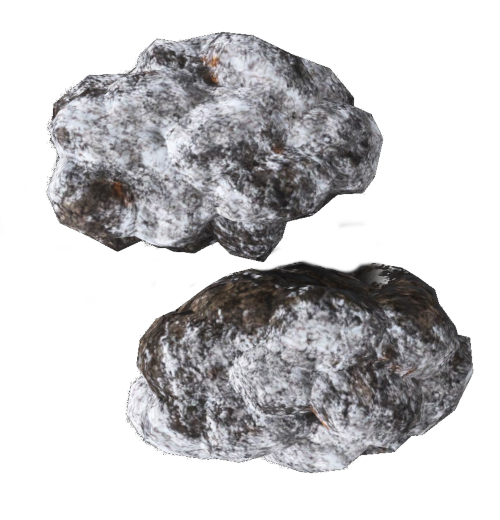
Ranta Dung
A dry cube-shaped dung that comes from a large isopod-like crustacean known as a ranta. It has recently been discovered that the dung contains a unique bacterial biome that helps the ranta process and digest minerals. Some researches are hopeful it will lead to industrial or medical innovations.
Hadanite
A crystal oscillator sought out for it's extremely high frequency of vibration which makes it useful in various applications.
Dolivine
A dull green gemstone that is used decoratively but also can be used for industrial purposes thanks to its resistance to weathering and high density.
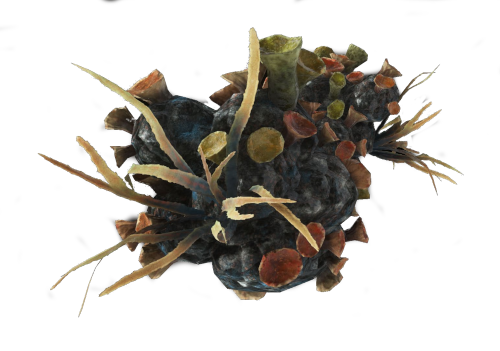
Revenant Pods
Contrary to its ominous name, the revenant is actually a variety of the altrucia tree, an indigenous plant of Terra known for its thick and colorful leaves. Geoengineers introduced fields of altrucias to Hyperion in an effort to break up the dust storms. Although the project failed, the altrucia tree adapted to the perpetual wind patterns, shedding its leaves and thickening the wood in the trunk. Botanists initially believed that the atrucia had died, but on closer inspection, discovered that they were quite alive and thus, the name was born. The pods are collected because the pollen is processed and turned into altruciatoxin.
Amioshi Plague
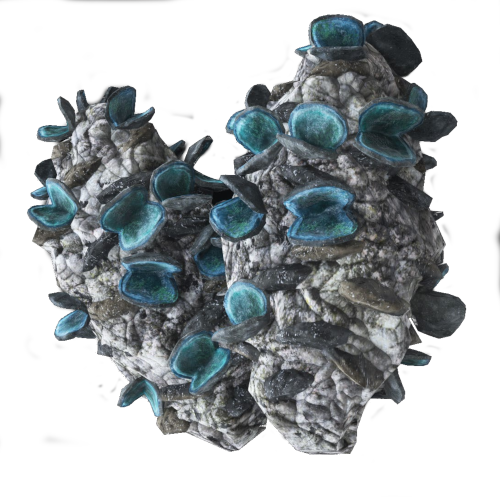
Not nearly as ominous as its name, the amioshi plague is an invasive lichen that grows in the cracks of rocks. While the core of the lichen burrows out of sight to try and absorb as much moisture as it can find, the part near the surface sprouts hooded scales that eject spores to spread to other rocks. Its relatively short maturation period is the origin of its name.
Prota
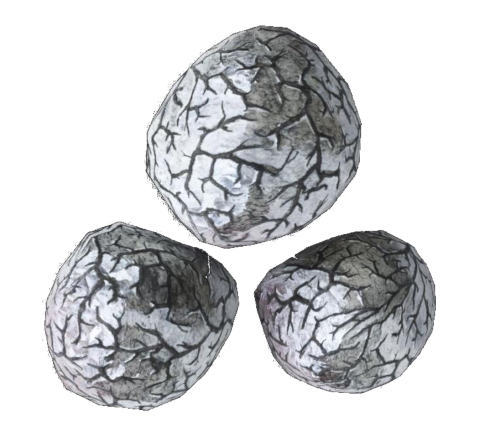
A resilient slime mold that can form in extremely corrosive environments and pressure, prota secretes a strong adhesive that can be distilled into a commercial-grade glue.
Compboard
A main processing unit used inside various computers and electronics.
Aphorite
Decorative jewel crystal prized for its multi-hued tones.